Detecting robot failures with limited fault data
In continuous manufacturing operations, unexpected industrial robot failures can lead to costly production downtime and delivery delays. However, normal operating patterns can vary significantly depending on the robot’s task, posture, and direction of movement, making it difficult to define a single threshold for anomaly detection.
Early signs of mechanical degradation, such as gearbox wear or bearing damage, are also difficult to identify through visual inspection and may go undetected until they develop into equipment failures.
Learning robot dynamics for anomaly detection
We developed a TCN-based predictor that estimates normal joint torque from joint angle, angular velocity, and angular acceleration, learning the robot’s underlying Euler–Lagrange dynamics.
The difference between measured and predicted torque is used as an anomaly score, enabling the model to detect changes in the robot’s physical behavior without requiring fault data for training.
Reducing false positives while detecting early degradation
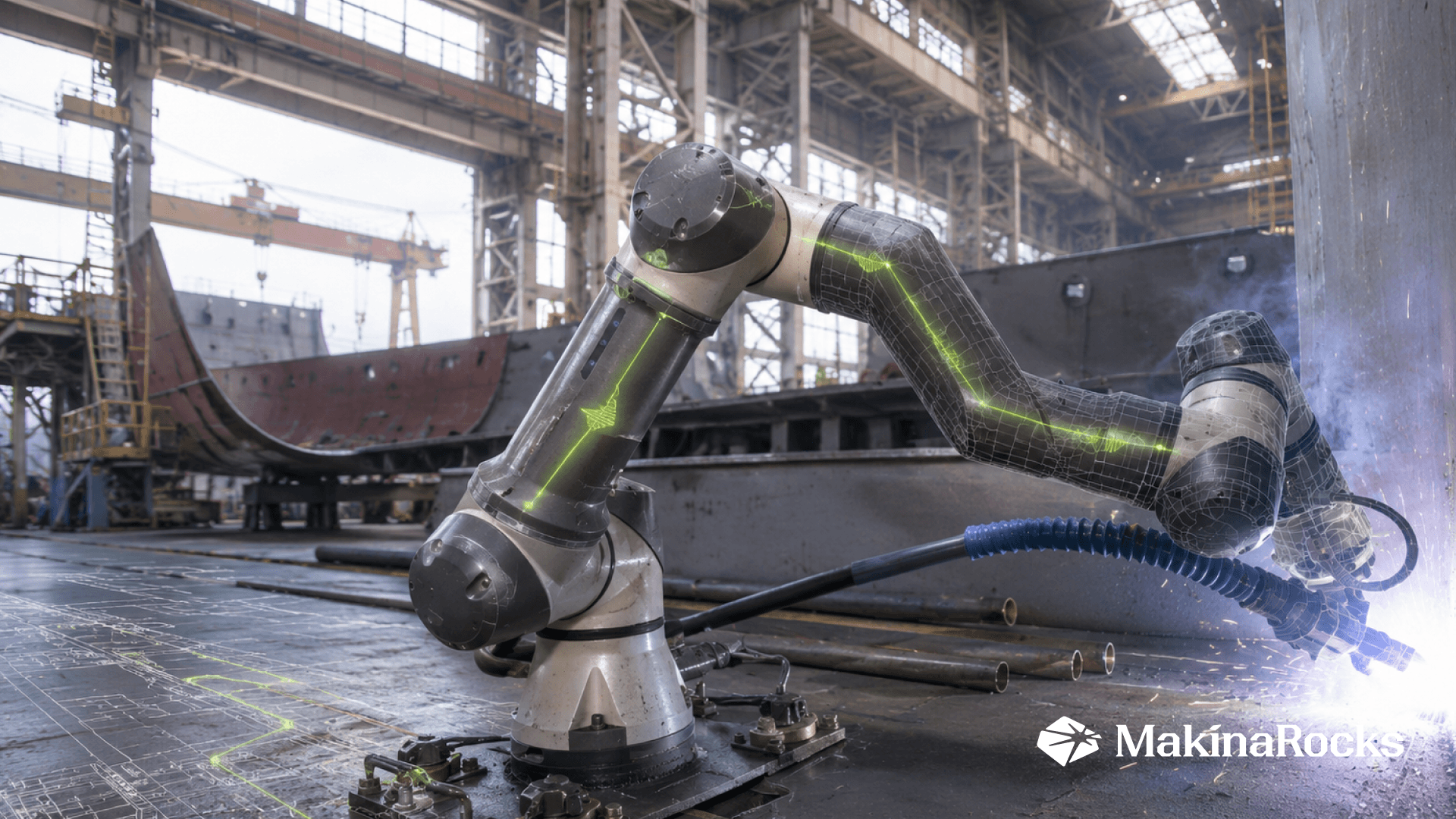
Applied to welding robots in a shipyard, the model maintained stable anomaly scores during normal operation while showing clear increases under simulated fault conditions.
The results demonstrated that the model can reduce false positives caused by changes in operating conditions while remaining sensitive to early signs of equipment degradation, enabling predictive maintenance using only normal operating data.