Connecting fragmented data and complex dependencies
Critical logistics and construction data was distributed across multiple internal systems, requiring teams to manually collect and consolidate information even for routine queries. This also made it difficult to understand how a delay or issue in one area could affect related processes and schedules.
Many operational questions depend on relationships between data—for example, identifying which processes, schedules, and owners are affected by a specific material issue. Traditional document- or table-based search could retrieve individual records but struggled to connect these dependencies and provide the broader operational context.
Combining knowledge graphs with an LLM agent
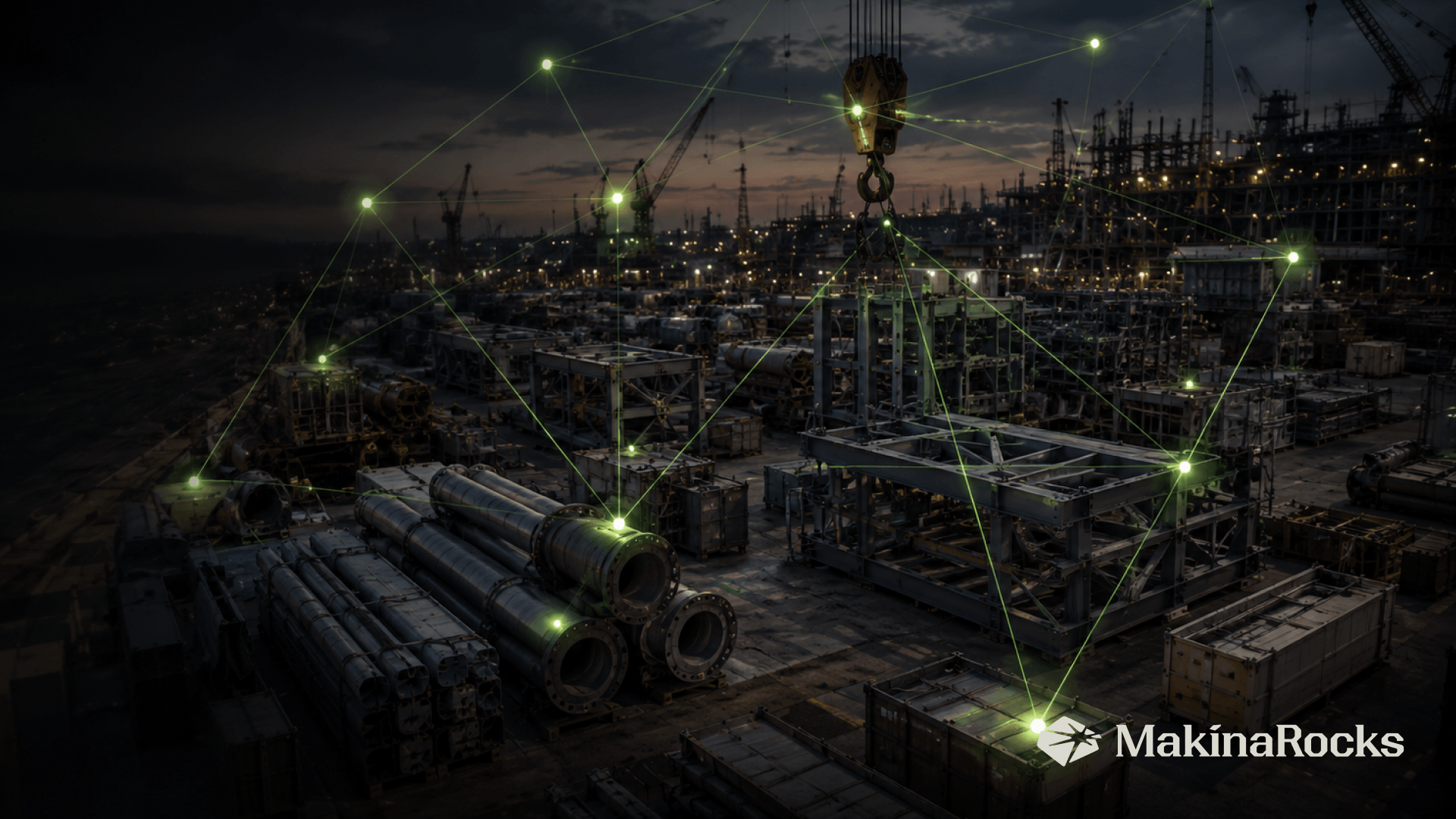
We built a Graph DB that integrates key operational data and maps relationships between materials, processes, schedules, owners, and issues. A daily data pipeline keeps the graph up to date, enabling responses based on the latest available information.
When a user submits a question, the LLM agent identifies relevant entities, traverses the Graph DB to retrieve their relationships, and performs additional search and validation before generating a response. Unlike conventional vector-based RAG, which primarily retrieves semantically similar content, Graph RAG provides the LLM with structured context based on explicit relationships between entities.
Identifying dependencies and downstream impact with a single query
Users can now access integrated logistics and construction information—including schedules, delays, and related issues—through a single natural-language query instead of navigating multiple systems.
The agent enables users to analyze schedule impact and quickly identify critical paths and delays without complex interfaces or code. Interconnected relationships across materials, owners, schedules, issues, and communications can also be traced through the Knowledge Graph, reducing the need for manual cross-referencing and enabling faster assessment of downstream impact.