Moving beyond hardware-centric production control
Enabling flexible, software-driven control of traditionally hardware-centric production lines required specialized AI agents capable of connecting real-time shop-floor data with LLMs to make decisions and execute control actions across manufacturing processes.
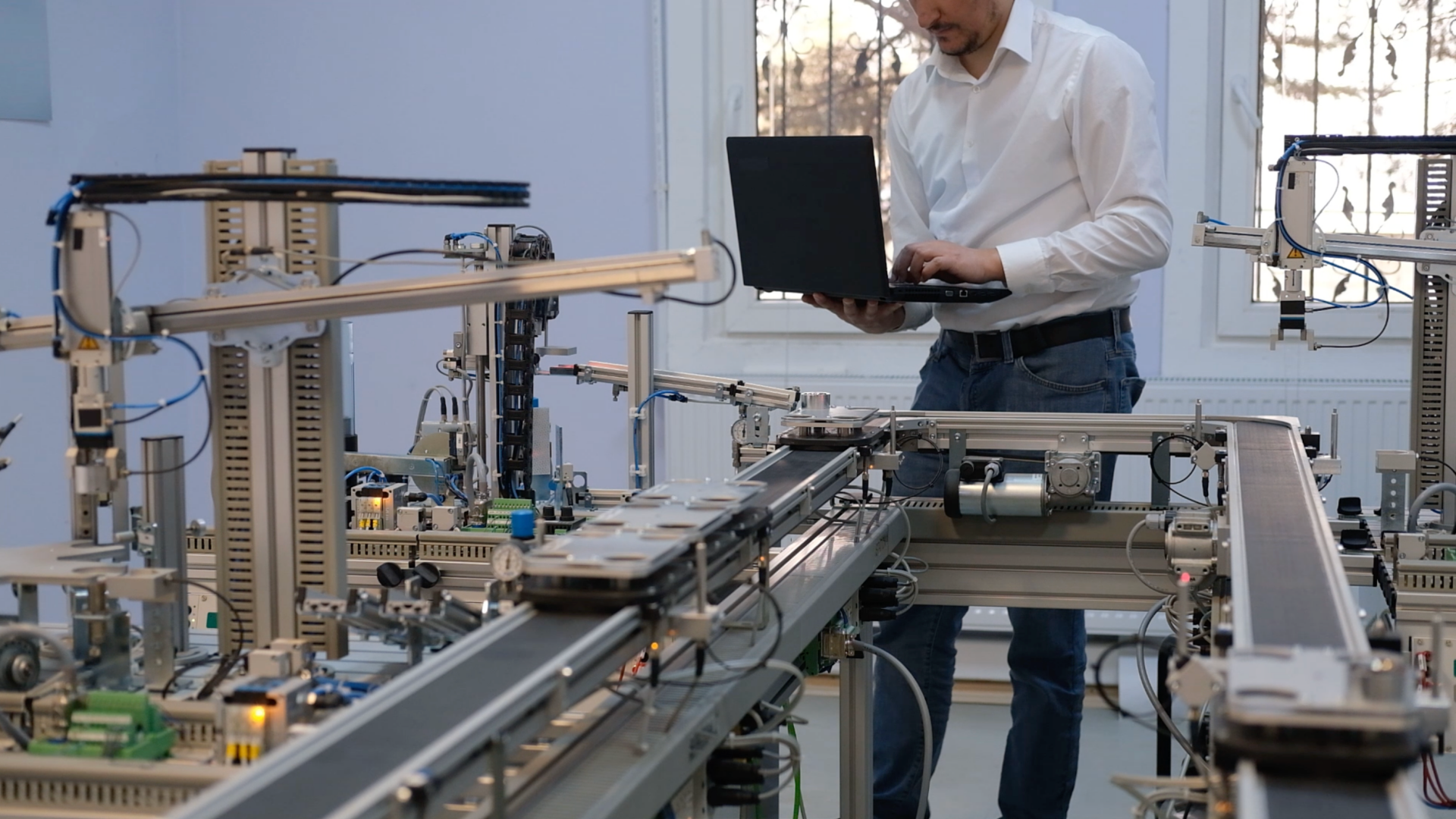
The system also needed to operate entirely on-premises, allowing AI agents and LLMs to run independently without external network connectivity. This required integrating multiple data sources—including PLCs, MES, and local PCs—and validating the entire architecture through testing on an actual production line.
Agentic AI and autonomous PLC control in an SDF
We designed specialized AI agents for different process requirements and implemented generative AI capabilities for production data analysis and visualization, including chart generation, correlation analysis, and statistical analysis.
We also validated AI-driven equipment parameter control, including restarting equipment after detecting false rejects in vision inspection and automatically adjusting optimal torque settings for press jigs. Real-time cycle time monitoring and natural-language-based PLC data processing were integrated with the backend architecture, enabling the system to dynamically adjust control timing based on production conditions.
Improving quality consistency and reducing manual intervention
By continuously collecting and analyzing real-time production data, the Agentic AI system connects previously fragmented AI models and factory systems into a unified data flow while enabling autonomous PLC control.
Real-time monitoring and response help shorten production cycle times and maintain stable equipment performance. The system proactively adjusts control parameters within predefined operating limits as production conditions change, helping maintain consistent quality despite changes in the operating environment.
AI agents also use broader process context to revalidate outputs from individual line-level models and filter false rejects, improving the accuracy of quality predictions. Automating repetitive control parameter adjustments reduces manual workload for operators, allowing them to focus on higher-value tasks while laying the foundation for more autonomous, software-defined production.