As more organizations move AI models into production, more enterprises are evaluating MLOps platforms. Experiment management, model deployment, and automated retraining pipelines have become baseline operational requirements for AI projects.
Recent conversations with MakinaRocks customers reflect the same shift. In the past, discussions often began with “What is MLOps?” and “Why do we need it?” Today, most organizations already understand the need. The question has shifted from “Should we adopt MLOps?” to “Can it scale to support our operating environment?”
As the number of models and teams grows—and operating environments span cloud, on-premises, and air-gapped infrastructure—experiment management and deployment automation alone are no longer enough. The critical question is no longer whether you can deploy a model.
What matters more is whether multiple teams can develop, deploy, and operate AI under consistent standards—and whether those processes can be governed and traced.
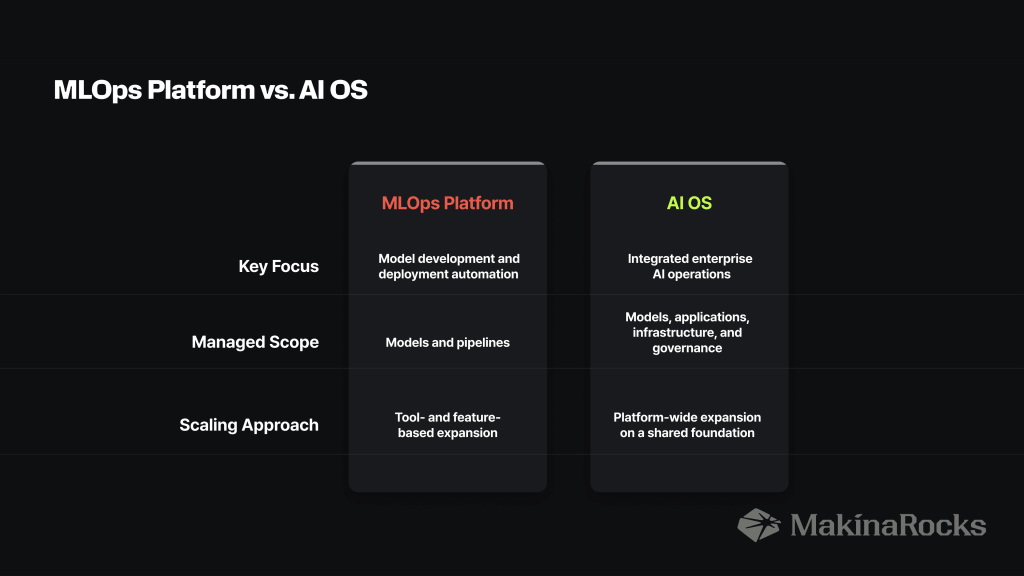
While an MLOps platform typically focuses on model development, experiment management, and deployment automation, an AI OS covers a broader operational scope. It provides a shared foundation for managing data, models, applications, GPU resources, access controls, security, and audit logs.
If the concept is new to you, check th What is AI OS? How Enterprises Build AI Capability from Within.
Before Adopting an MLOps Platform, Check the Signs You Need an AI OS
This checklist helps determine whether your current challenges are limited to specific MLOps capabilities, such as experiment management or model deployment, or have expanded to infrastructure, security, resource management, and application operations—indicating the need for an integrated AI operating environment.
Check every statement that applies to your organization.
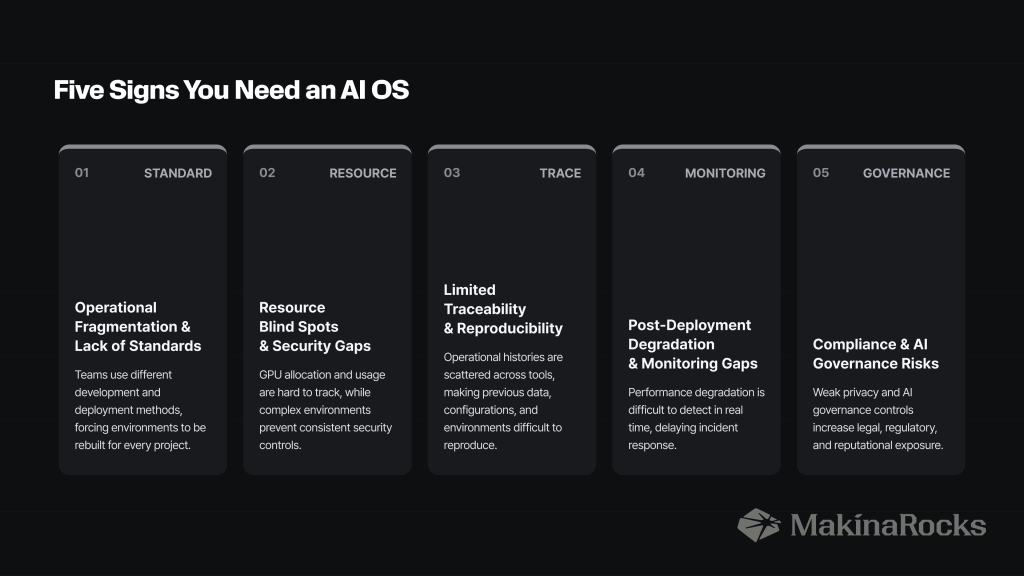
[Image: Five Signs You Need an AI OS]
1. Operational Scale and Standardization
Determine whether AI operations are expanding beyond a single team and becoming an organization-wide concern.
- Two or more teams or business units are operating AI models or AI applications.
- Each team uses different development environments and deployment methods, requiring the operating environment to be rebuilt for every new project.
- As the number of models and applications grows, the organization needs shared standards for development, deployment, and operations.
2. Reproducibility and Operational Automation
Determine whether model operations depend on individual expertise rather than repeatable processes.
- It is difficult to identify and reproduce the data, code, configurations, and runtime environment used for a previous model.
- Deployment, retraining, monitoring, and rollback depend on manual work by specific individuals.
- Code, experiment, model, and deployment histories are scattered across different tools, making the end-to-end workflow difficult to trace.
3. Security and Governance
Determine whether consistent controls are required across the entire environment in which AI runs—not just for individual models.
- AI must operate across on-premises infrastructure, private clouds, air-gapped networks, or hybrid environments.
- SSO and role-based access control must be applied consistently across multiple AI tools.
- You need to track who accessed or modified specific data, models, and applications.
4. GPU and Model Serving Operations
Determine whether model operations and infrastructure resource management need to be managed together.
- Multiple teams and projects share GPUs, making it difficult to understand allocated capacity and actual utilization.
- GPU capacity remains idle while workloads that need resources repeatedly face shortages.
- Model deployment status, inference performance, and GPU utilization are monitored across separate dashboards and tools.
5. Fragmented Tools and Operating Environments
Determine whether the cost and complexity of integrating and maintaining specialized tools are increasing.
- Separate tools are installed and operated for code management, experiment tracking, workflows, model serving, and monitoring.
- Authentication, permissions, and operational histories are managed separately for each tool.
- Deployment environments and security configurations must be rebuilt whenever a new tool or AI application is introduced.
Review Your Checklist Results
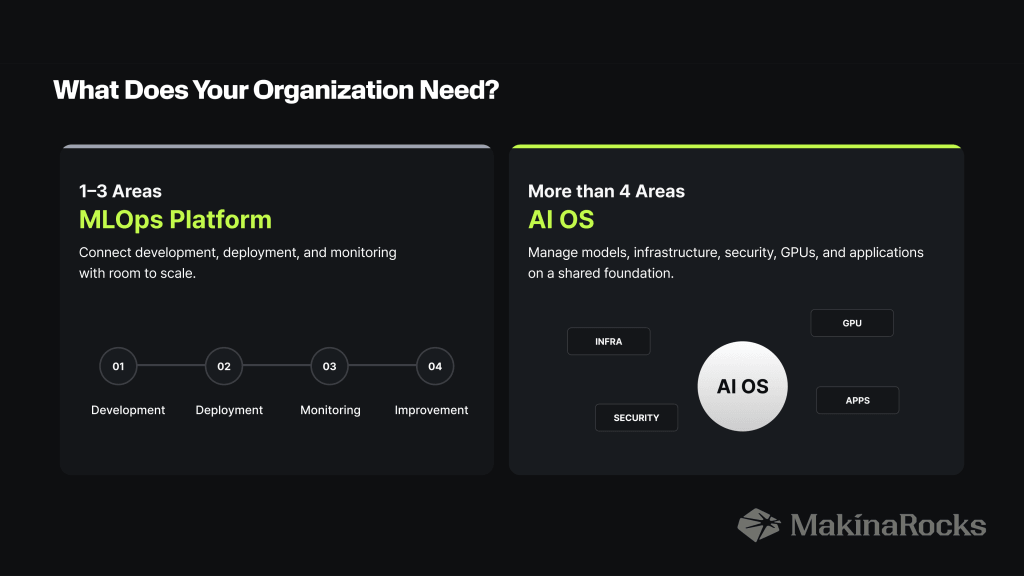
[Image: What Does Your Organization Need?]
Your challenges are concentrated in a specific area. Start with individual MLOps tools that address the highest-priority needs, such as experiment tracking, a model registry, or deployment automation.
If Two or Three Areas Apply
Your challenges span multiple stages, from development and deployment to monitoring. Rather than adding individual tools one at a time, it may be time to evaluate an integrated MLOps platform that connects the entire workflow.
In addition to the capabilities you need today, determine whether the platform can scale to support access control and resource management as the number of teams, models, and infrastructure environments grows.
If Four or Five Areas Apply
Your operational challenges have expanded beyond model development and deployment to include infrastructure, security, resources, and application operations.
At this stage, connecting more tools is unlikely to solve the underlying problem. You need an AI OS approach that manages data, models, applications, GPUs, permissions, and audit logs on a shared operational foundation.
If security and governance apply to your organization alongside challenges in at least two other areas, you should evaluate an integrated AI operating environment regardless of the total number of areas selected.
[Image: MLOps Platform vs. AI OS]
Runway Is an AI OS That Unifies All Five Criteria on One Operational Foundation
Each organization must first define its operational objectives, KPIs, responsibilities, and approval processes. A platform cannot define an enterprise’s operating policies on its behalf.
Runway helps organizations apply those policies consistently across teams, models, and applications by connecting development, deployment, resource management, and security on a shared foundation.
Evaluate How You Will Operate at Scale, Not Just the Features You Need Today
When choosing an MLOps platform, the number of available features is not what matters most.
Instead of asking only whether the platform can deploy your current models, consider whether it can preserve a consistent operating model as the number of models and teams grows. If every new tool requires separate authentication and permission settings, GPU and deployment environments must be managed independently, and operational histories must be collected from multiple systems, complexity will remain even after the platform is introduced.
If your immediate needs are experiment tracking and deployment automation, an MLOps platform may be the right place to start. But when AI expands across multiple teams and business functions—and security, permissions, GPUs, and applications must be managed under consistent standards—you need a broader operational foundation.
Runway does not replace MLOps. It includes experiment management, model deployment, pipelines, and monitoring, while extending that foundation to applications, infrastructure, security, and resource management.
Keeping AI from multiple teams operating consistently within enterprise standards is the goal of Runway as an AI OS.