Why AI projects fail in production
Anyone who has ever tried to move an AI project into production will recognize this pattern. The model delivers strong accuracy, the executive demo goes well, and the budget gets approved. But once the system enters production, the cracks begin to show. It does not connect cleanly with existing systems, a single model update can disrupt service, ownership shifts, and the project slowly loses traction.
This is not a problem limited to a few organizations. A study by the MIT NANDA research group analyzed 52 organizations and more than 300 AI initiatives, finding that while 20% of enterprise AI projects reached the pilot stage, only 5% made it into production successfully.
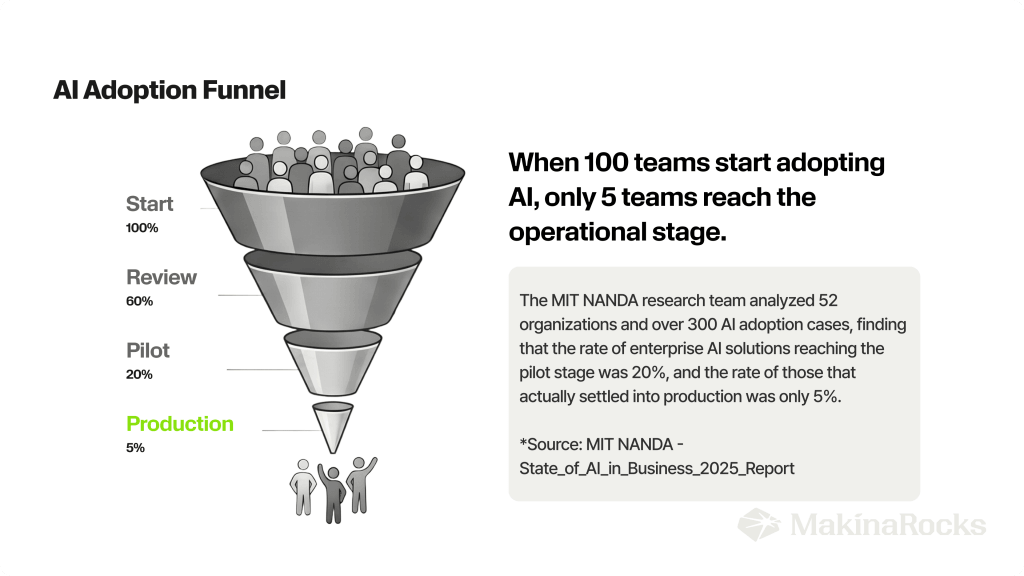
[Image: Out of 100 teams starting an enterprise AI PoC, only 5 reach production]
The real issue is operation, not the model
When AI initiatives fail, many organizations point to model quality or data limitations. In practice, the more common issues are different: AI does not fit into existing workflows, and it does not keep improving over time.
The deeper problem is that many companies try to layer AI on top of the way they already work. But AI is not just another feature to be added to an existing strategy. To make AI work, the operating model itself has to change.
- From collecting more data to designing data pipelines AI can actually use.
- From cutting costs to creating measurable value from those costs.
- From human-led incident response to systems that detect and recover on their own.
Without that shift, the pattern repeats itself: PoC succeeds, production fails.
![[Image: Two approaches to AI adoption]](/wp-content/uploads/2026/06/Image-7-1024x576.png)
[Image: Two approaches to AI adoption]
Four reasons AI production fails
![[Image: 4 Barriers Blocking Enterprise AI in Production]](/wp-content/uploads/2026/06/Image-5-1024x576.png)
[Image: 4 Barriers Blocking Enterprise AI in Production]
1. AI does not connect with existing systems
PoC environments are designed to be controlled. The data is curated, the user base is limited, and the impact of failure is relatively small. Production is a different world. AI has to connect with existing data pipelines, support real operational workflows, and work smoothly with systems already in place.
When that connection is weak, AI stays in the “nice to try” category. Teams fall back to familiar processes, and the AI ends up sitting in a separate screen instead of becoming part of daily work.
2. Model updates become a production risk
The hard part is not the first deployment. It is everything that comes after it: continuous improvement, retraining, and redeployment. Even a small model change can trigger unexpected behavior, which means validation, service stability, rollback planning, and ownership all have to be considered together.
That is why many organizations avoid making updates. The original PoC model stays in production far too long, and over time the system drifts away from the business it was meant to support.
3. Feedback does not turn into improvement
People keep using AI because they expect it to get better with time. But in many enterprise environments, usage logs and frontline feedback never make their way back into retraining or optimization workflows.
The result is frustratingly familiar: users repeat the same inputs, and the AI makes the same mistakes. Trust weakens, and adoption stalls.
4. Perceived value matters more than technical capability
Employees do not judge AI by whether it has been deployed. They judge it by whether it actually makes their work easier. If the value is not obvious, they turn to their own tools, and the official system slowly gets bypassed.
Research on customer support agents shows that generative AI can improve productivity, but the effect depends heavily on user skill and work context. In other words, successful enterprise AI has to do more than automate tasks — it has to help people do their jobs better. Adoption only scales when users feel real value in their day-to-day work.*
Where does your organization get stuck?
If your PoC worked but production is still a challenge, these questions can help you assess where things stand.
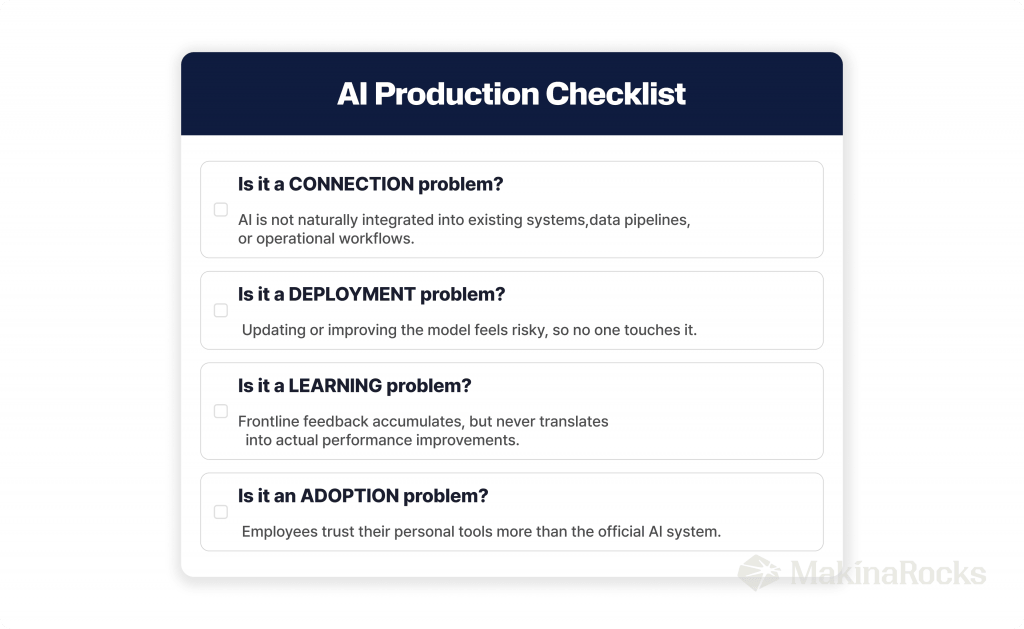
[Image: AI Production Checklist]
Why AI OS changes the game
he four barriers above share one common root cause: they are not model problems, but production architecture problems. That changes the premise. AI should not be treated as a one-time project. It should be designed as a system that runs continuously in production. And that system needs a foundation: an AI Operating System, or AI OS. Runway is both an MLOps platform and an AI OS, built to manage everything from ML workloads to generative AI under a unified governance layer. In the end, the production challenges above have to be solved at the platform level.
Solving the challenges at the platform layer
Integration starts with a unified architecture
AI needs to connect with existing workflows from day one. When ML workloads and applications run on the same platform, organizations avoid the pain of re-architecting infrastructure as they move from PoC to production.
Model updates need zero-downtime progressive deployment
In production, model deployment should be a routine part of operations — not a high-risk event. A single serving endpoint should support traffic splitting so new models can be validated safely, with rollback ready if something goes wrong. That turns model updates into a normal part of the production lifecycle.
Learning depends on continuous training
If feedback keeps piling up but the AI never improves, the issue is usually clear: production data is not flowing back into the training pipeline.
A production-ready AI system needs performance monitoring, anomaly detection, retraining triggers, validation, and seamless redeployment. Without that loop, the model launched on day one effectively stays the “latest version” forever. Runway provides the monitoring and infrastructure needed to make that lifecycle real.
Adoption comes down to value optimization
The goal is not simply to save GPU usage. The goal is to create more value from the resources already available. Training, inference, and development workloads need to run efficiently on shared infrastructure.
At the end of the day, the quality users feel comes from production efficiency.
Production-ready AI starts here
Even the best architecture will not scale without the infrastructure to support it. And that leaves one fundamental question:
Is your infrastructure truly ready for production?
*Source: Kitsios, F., & Kamariotou, M. (2021). Artificial Intelligence and Business Strategy towards Digital Transformation: A Research Agenda. Sustainability, 13(4), 2025.