When people hear the term Physical AI, they often think of humanoid robots or autonomous vehicles—the most visible, headline-grabbing examples of AI acting in the physical world.
But manufacturing is where Physical AI is already making some of its biggest impact. Picture a “dark factory”—lights off, no one on the floor, machines running through the night on their own. That’s what happens when Physical AI combines with physical equipment to perceive, decide, and execute without a person in the loop. It’s perhaps the clearest vision of autonomous manufacturing—and it’s quickly becoming reality.
So what does Physical AI actually look like on the factory floor? From the engineering drawings that define a product to the AI operating system that manages enterprise-scale AI, here’s how MakinaRocks is laying that foundation today.
1️⃣ Engineering drawings: Where manufacturing begins
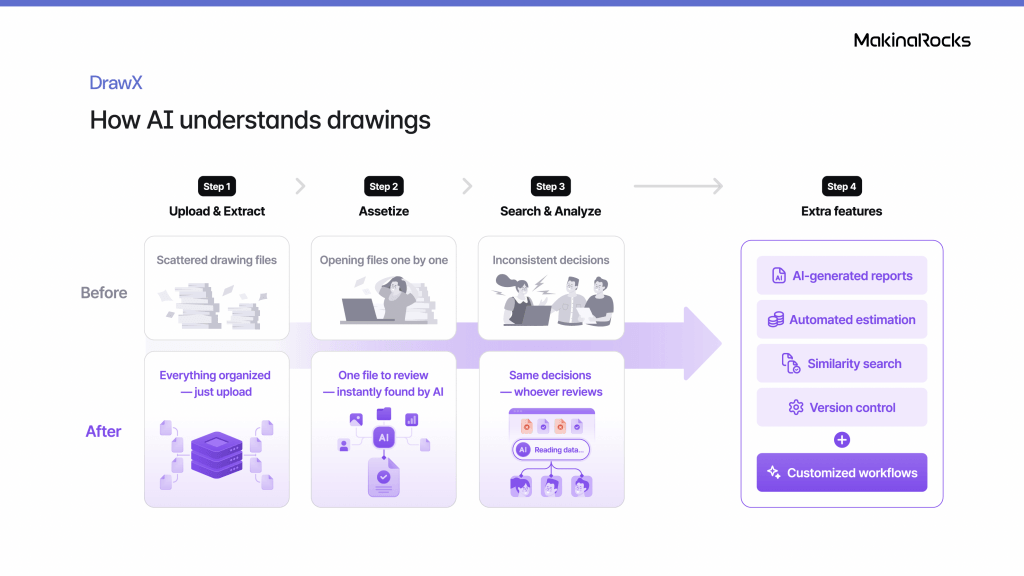
Every manufacturing process starts with engineering drawings. They define how products, equipment, and production systems are built in the physical world.
Yet in most organizations, drawings are scattered across multiple systems, duplicated across versions, and disconnected from related information like bills of materials (BOMs), quotations, and procurement documents. This fragmentation slows collaboration and creates unnecessary operational drag.
MakinaRocks’ AI-powered drawing management solution, DrawX, brings these assets together into a single intelligent platform. As soon as drawings are uploaded, AI converts them into structured data and automatically organizes their version history and hierarchical relationships.
DrawX also connects engineering drawings to BOMs, quotations, purchasing documents, and other project data, giving engineering and manufacturing teams a unified view from design through execution.
Built on this structured engineering knowledge, AI can automatically search, analyze, compare, estimate, and interpret drawings, turning manual engineering workflows into standardized, AI-driven decisions.
🔗 DrawX: The AI agent for engineering intelligence
2️⃣ Vision AI that turns design intent into autonomous welding
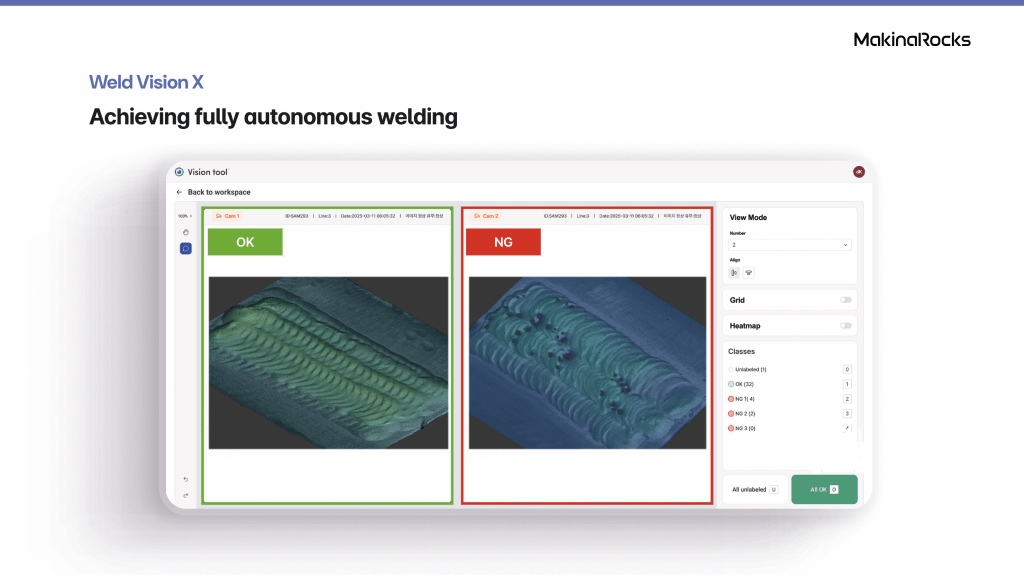
Vision AI enabling autonomous welding
Engineering drawings define the intent. Physical AI turns that intent into action.
Welding is a clear example.
MakinaRocks’ welding AI combines 3D vision with Physical AI to perceive real-world manufacturing conditions as they actually are—not as a drawing assumes them to be. Rather than following a predefined path, the system continuously reads machining tolerances, thermal deformation, and material distortion, then generates and adjusts welding paths and process parameters in real time.
Path planning, welding, and inspection become a single autonomous workflow. The system perceives, decides, and executes without waiting for a human to intervene between steps. It also performs high-precision 3D bead inspection, automatically classifies irregular defects, and enables 100% inline quality inspection without interrupting production.
🔗 AI vision agents that perceive, decide, and execute
3️⃣ Specialized AI that solves manufacturing problems
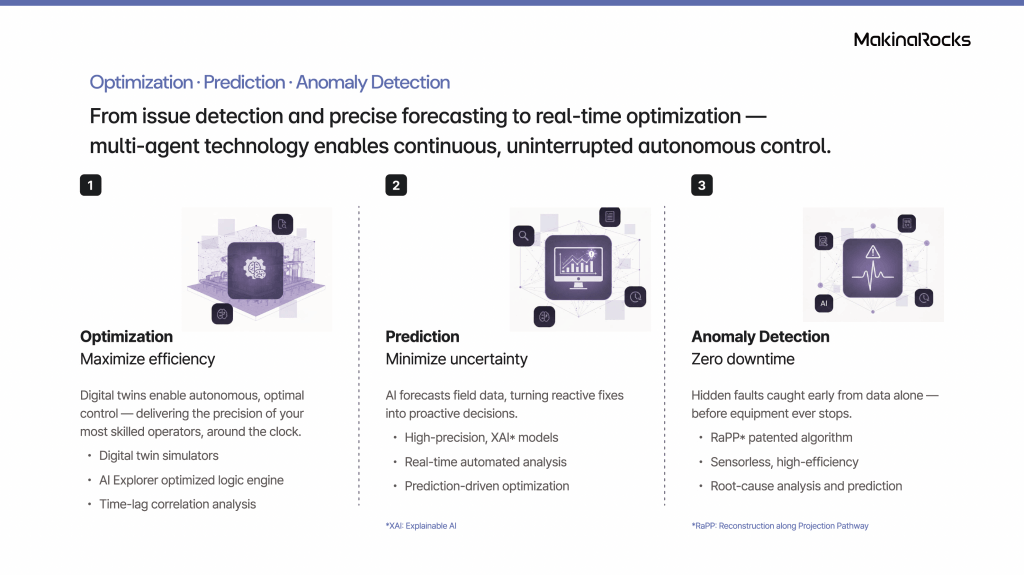
Specialized AI for industrial operations
For most manufacturers, the AI journey doesn’t begin with full autonomy. It begins with solving one operational problem.
Unexpected equipment failures. Variations in product quality. Inefficient process conditions. These practical, expensive problems are usually the first place AI creates measurable business value.
MakinaRocks develops specialized AI for predictive maintenance, anomaly detection, optimization, and forecasting. These models monitor equipment health, flag failures before they happen, tune production parameters, and catch abnormalities early, reducing operational risk on the lines that manufacturers can least afford to stop.
By focusing on high-impact problems first, manufacturers see results quickly and build internal confidence to expand AI further. Just as important, every deployed model and every hour of operational experience becomes the foundation for the next process, the next line, and the next plant.
🔗 Specialized AI that thinks, decides, and acts
4️⃣ Building the software-defined factory
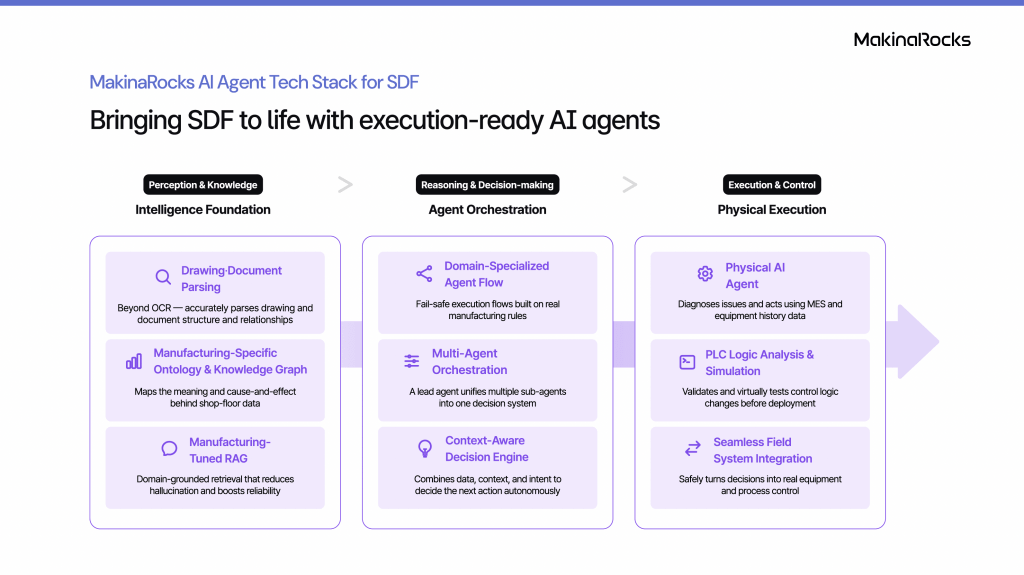
Multi-agent AI powering the Software-Defined Factory
Once AI proves its value in individual applications, it can scale across the entire factory.
MakinaRocks’ Physical AI extends beyond individual machines or production lines into the Software-Defined Factory (SDF), where autonomous manufacturing stops being a single use case and becomes the way the entire plant operates.
Inside an SDF, sensors continuously collect operational data while AI models, intelligent agents, and connected systems interpret changing factory conditions in real time. AI detects anomalies, predicts what’s likely to happen next, and continuously determines the optimal operating state for production. Based on those decisions, AI agents autonomously control equipment and coordinate operations across the factory.
The shift is structural. Instead of people manually supervising every process, decision-making moves to AI while execution becomes increasingly automated—perceive, decide, and execute—at the scale of an entire factory rather than a single machine.
🔗 Building a software-defined factory (SDF) with multi-agent systems
5️⃣ The AI operating system behind Physical AI
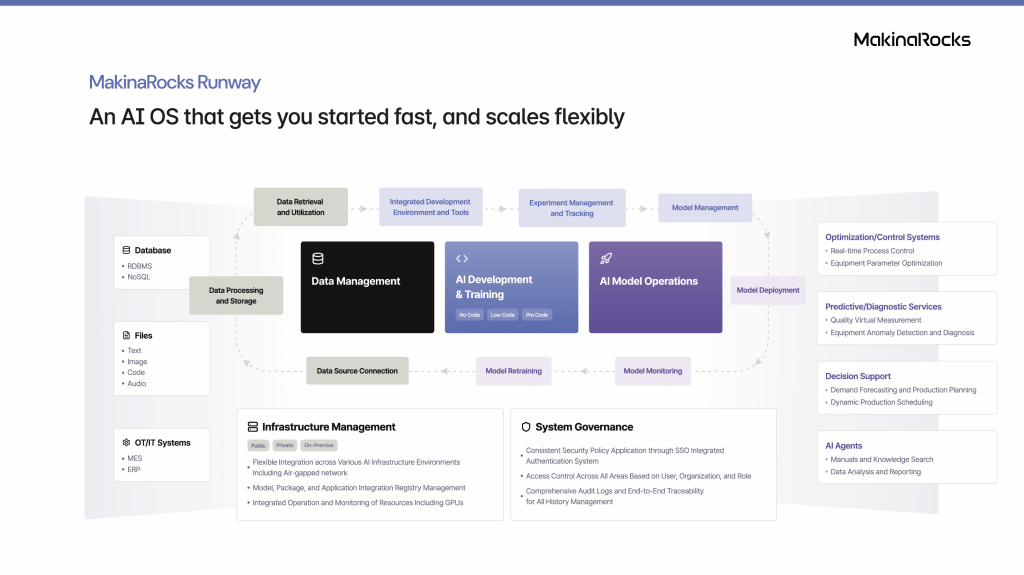
Runway, the AI Operating System for Physical AI
Behind every successful Physical AI application is an enterprise platform capable of building, deploying, operating, and continuously improving AI at scale.
That platform is Runway, MakinaRocks’ AI Operating System.
Runway provides the development and operational environment for every AI application described above—from engineering drawing intelligence and vision AI to predictive maintenance, optimization, and autonomous control.
AI models have to be continuously trained, monitored, deployed, and updated as production environments change. Runway lets organizations manage the entire AI lifecycle in one unified platform, turning AI from a collection of isolated pilot projects into a long-term enterprise capability and a strategic business asset.
🔗 Runway: The AI operating system for Physical AI
6️⃣ Physical AI proven across industries
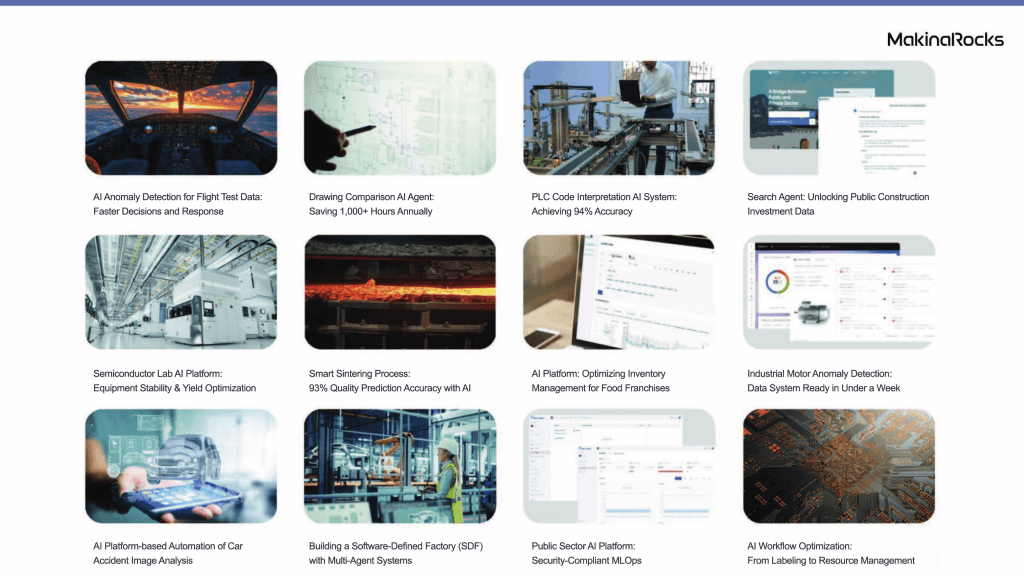
Physical AI deployed across industries
Physical AI isn’t limited to one manufacturing process or one industry.
MakinaRocks’ AI solutions are deployed across automotive, robotics, semiconductors, batteries, energy, and defense, helping organizations solve some of their most complex operational challenges.
Beyond the examples above, our growing portfolio of industrial AI deployments shows how Physical AI is improving productivity, quality, operational resilience, and decision-making across diverse operating environments.
🔗 Explore Physical AI use cases across industries
Physical AI is redefining how industrial organizations operate.
By combining engineering knowledge, industrial data, AI models, and intelligent agents, MakinaRocks connects digital intelligence with physical execution, enabling AI to perceive, decide, and execute across equipment, production systems, and entire factories.
Most manufacturers don’t start with a fully autonomous factory. They start with one problem: an unpredictable failure, a quality issue that won’t go away, or a process running below its potential. That’s the right place to start.
If you’re figuring out where Physical AI fits into your operation, let’s talk.
We’ll help you identify the right starting point—and build a roadmap to autonomous manufacturing from there.
Note: This post was translated from the original Korean version by Kyoungyeon Kim.