
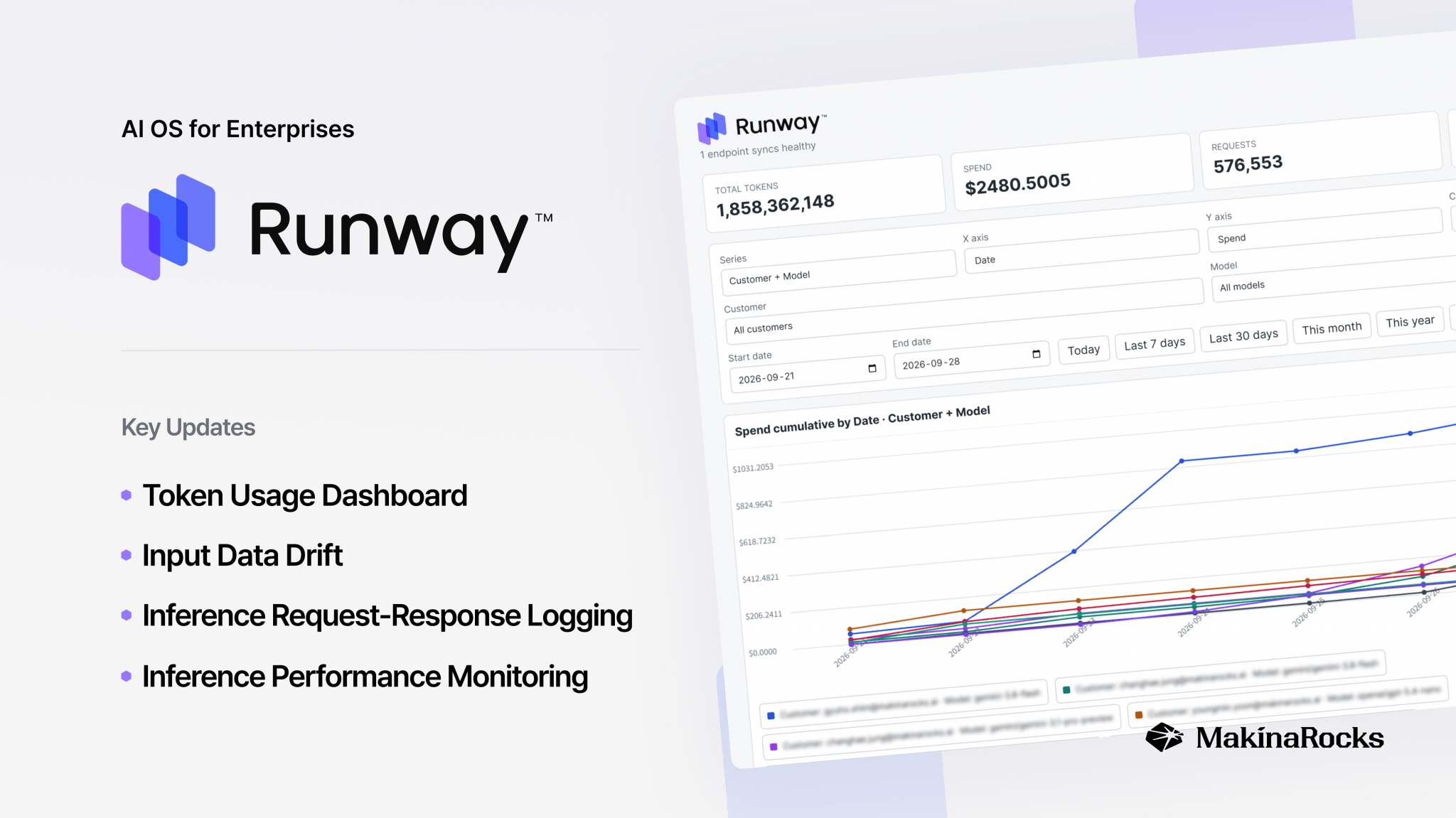
Unified LLM token usage dashboard, data drift detection and enhanced observability capabilities simplify AI operations and management
Update strengthens “Enterprise AI Sovereignty,” giving enterprises greater control over AI performance, resources and costs
SEOUL, South Korea, September 30, 2026 — MakinaRocks, South Korea’s leading Physical AI company, today announced Runway 2.4.0, the latest release of its AI operating system (AI OS), introducing expanded capabilities for monitoring and managing AI performance, infrastructure resources and costs.
Runway connects data, models and operational systems to help enterprises deploy and operate AI in real-world environments. The platform supports the full AI lifecycle—from development and deployment to monitoring and retraining—across cloud, on-premises and air-gapped environments.
Runway 2.4.0 expands the platform’s governance and observability capabilities, giving enterprises greater visibility and control over AI performance, infrastructure utilization and costs. The release introduces new capabilities across four key areas:
- Cost visibility: A unified token usage dashboard provides visibility into LLM consumption across organizations, projects and models.
- Model observability: Input data drift detection, inference request/response logging and inference accuracy monitoring help teams identify potential model degradation and determine when models need to be revalidated or retrained.
- Infrastructure monitoring: Pod-level resource monitoring and hierarchical usage statistics provide granular visibility into GPU, CPU, memory and storage utilization.
- Data management: Storage browser upload and download capabilities simplify file management directly within Runway.
Together, these capabilities advance what MakinaRocks calls Enterprise AI Sovereignty: the ability for enterprises to retain control over how their AI is deployed, operated, governed and optimized across infrastructure environments.
A key addition in Runway 2.4.0 is the unified token usage dashboard. As enterprise use of large language models (LLMs) expands, tracking and controlling token consumption across teams, projects and deployment environments has become increasingly important. Runway consolidates previously distributed usage metrics into a single dashboard, allowing organizations to monitor token consumption by organization, project and model. Because usage can be aggregated across both on-premises and cloud deployments, enterprises can maintain consistent cost visibility across hybrid AI infrastructure and identify opportunities to reduce unnecessary consumption.
The release also expands Runway’s model observability capabilities. Input data drift detection automatically compares incoming data for deployed models against a defined baseline, such as training data, to identify changes in data distribution. This allows teams to detect potential model degradation even before ground-truth labels become available. User-defined thresholds can trigger automated alerts, enabling teams to investigate changes before they affect operational performance.
Runway 2.4.0 also adds inference request/response logging, which automatically records model inputs and outputs, and inference accuracy monitoring, which tracks model accuracy against user-provided ground-truth data. Together, these capabilities provide teams with data-driven signals for determining when models should be revalidated or retrained.
Infrastructure monitoring has also been expanded. Workload pod-level resource monitoring provides visibility into GPU, CPU, memory and storage utilization, as well as stability indicators such as restart counts, for individual pods running applications and models. Hierarchical resource usage statistics allow operators to analyze resource consumption by workspace, project, creator and workload, providing a clearer basis for capacity planning and resource allocation. Runway 2.4.0 also introduces browser-based storage upload and download capabilities for more streamlined data management.
By bringing AI performance, infrastructure utilization and cost management into a unified operating environment, Runway enables enterprises to establish stronger governance over AI systems as they move from development into production. This gives organizations greater control over critical AI assets and provides a foundation for operating AI on their own terms.
Earlier this year, Runway 2.0 introduced an open architecture, enhanced security policies and role-based governance capabilities. Runway has since expanded across manufacturing, defense, financial services and the public sector, including deployments in high-security and highly regulated environments at the Agency for Defense Development (ADD), K-water (Korea Water Resources Corporation) and the Korea Insurance Development Institute (KIDI).
“With Runway 2.4.0, enterprises can see not only whether AI performance is changing after deployment, but also how infrastructure resources and costs are being used,” said Sangwoo Shim, CTO of MakinaRocks. “The ability to observe, govern and optimize these systems under an enterprise’s own control is fundamental to Enterprise AI Sovereignty. Runway is designed to give organizations that control across the AI lifecycle.”
